Portrait of Dr. Chirananda De, smiling, in glasses and a striped polo shirt.

Chirananda De

Palaeontologist and ichnologist, Geological Survey of India, 1980 to 2012

He spent a working life reading the marks that living things leave in sediment: crab burrows on a Bengal beach, worm tubes in a Himalayan limestone, and the soft impressions of the earliest animals in the rocks of central India. From those traces he reconstructed shorelines, sea levels, and buried rivers, and found, in a Vindhyan sandstone, the imprint of rain that fell more than a billion years ago.

Born 8 September 1952, Kolkata. Director (Senior Grade), Palaeontology Division, on retirement in 2012.

Black and white photograph of a rippled sandstone surface pitted with small rain craters, with a coin for scale.
Rain craters, most with low rims, on a rippled glauconitic sandstone surface of the Semri Group, eastern Madhya Pradesh, about a billion years old. Coin for scale. Figure 7c in De, Current Science, 2001. Entered in Guinness World Records 2005 as the oldest known rain imprints.

A life in traces

1978 to 1981

Crabs on the Sundarban sand

The work began on the beaches of the western Sundarban, as a research fellow at Jadavpur University under Professor S. K. Bakshi. The question was simple and turned out to be a career: what do the burrows of living crabs tell you about the ground they dig in? His first paper, in 1980, described the workings of beach crabs on the Bengal delta. The habit of watching living animals make traces, and then looking for the same traces in old rock, never left him.

Beach at Digha with the backshore surface broken into slumped blocks by collapsing crab burrows.
The Digha backshore, undermined by Ocypode burrows and slumping after the tide. De, Current Science, 1998.
1980 to the mid-1990s

Ladakh, Gujarat, and the coalfields

He joined the Geological Survey of India in 1980 and was sent first to the Ladakh Project in Kashmir, mapping in the Zanskar Himalaya. There he found the hydrozoan Burgundia and used trace fossils to place the boundary between the Precambrian and the Cambrian in the Liddar valley. Six years in Gujarat followed, working the Quaternary deposits of the Banas river basin, where he developed a paraffin-wax method for casting burrows in loose sediment and began to use burrow orientation to find buried channels.

In the Gondwana coalfields of Orissa and Bihar he read marine signatures where none had been expected: stromatolites with trapped cyanophytes in the Talchir limestones, Skolithos burrows in the Barakar, and the oldest charophytes then known from India.

Plate of paraffin-wax casts of crab burrows showing I, J, Y and branching forms, with a knife for scale.
Paraffin-wax casts of Ocypode burrows from the Ganges delta beaches, made with the casting method he developed in the field. De, Ichnos, 2000.
1996 to 2009

The Vindhyan years

From the late 1990s his field seasons went to the Bhander Group of the Vindhyan Supergroup in eastern Madhya Pradesh, rocks laid down before there were animals with hard parts. On bedding planes there he recorded impressions he interpreted as Ediacaran organisms, the first such assemblage reported from the Vindhyans, published in the Journal of Asian Earth Sciences in 2003 and 2006 and taken up in an international review of Ediacaran biogeography.

In the same rocks he found something rarer still: a surface pitted with the craters of raindrops, preserved from a tidal coast more than a billion years old. The finding, published in Current Science in 2001, was picked up by the journal Science, drew a live BBC interview, and entered the 2005 Guinness World Records as the oldest known rain imprints.

Plate of photographs and interpretive line drawings of disc-shaped Ediacaran impressions from the Bhander Group.
Ediacara-type impressions from the Bhander Group with their interpretive drawings. De, Journal of Asian Earth Sciences, 2006.
1998 to 2012

Burrows put to work

Alongside deep time, he kept returning to the Bay of Bengal coast, and there he made ichnology useful. The tubes of the worm Diopatra, built differently above and below the sand, gave a way to measure a year's erosion or deposition on a beach in an afternoon. The mud volcanoes of the fiddler crab Uca marked the segments of shore that were least stable. Crab burrows at Digha explained why a resort beach was eroding. In drought-hit Banaskantha, oriented crustacean burrows pointed to buried aquifers.

He gathered this work into a biophysical model of beach-crab burrowing and, after retirement, into a Springer monograph on the ichnology of the Sundarban mangroves. His last posting was as Director of the Palaeontology Division in Jaipur, where with colleagues he reported Ediacaran and early Cambrian fossils from the Marwar Supergroup of Rajasthan.

Photographs of Diopatra worm tubes standing on an intertidal beach, with scale bars.
Diopatra cuprea tubes on Bay of Bengal beaches. The part built above the sand records a year's deposition or erosion. De, Marine Georesources and Geotechnology, 2002.

From the field

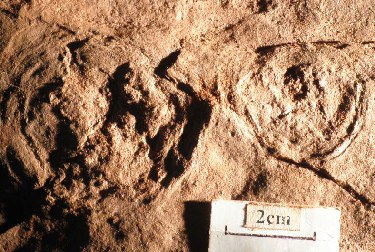
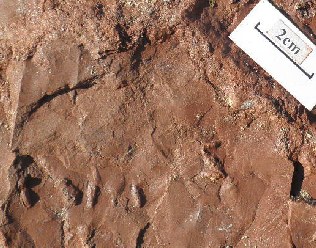
  • Disc-shaped fossil impression on red sandstone with a 2 cm scale bar.
    Discoidal Ediacaran impression on red sandstone of the Sonia Formation, Jodhpur Group, Rajasthan. Scale bar 2 cm. De and Prasad, 2012.
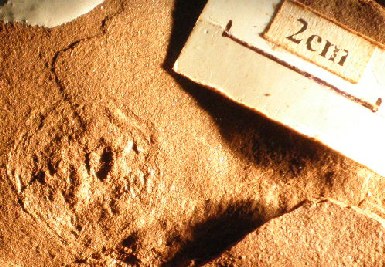
  • Second disc-shaped fossil impression on red sandstone with a 2 cm scale bar.
    A second disc from the same bedding surfaces, Sonia Formation. De and Prasad, 2012.
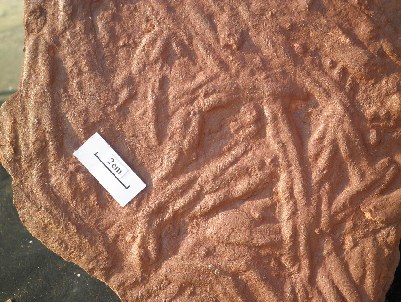
  • Sandstone surface covered with sinuous parallel ridges, with a 2 cm scale bar.
    Ridged bedding surface, Sonia Formation. De and Prasad, 2012.
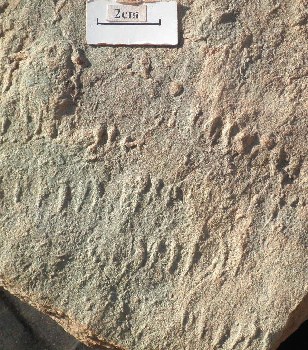
  • Elongate trace on a sandstone bedding plane with a 2 cm scale bar.
    Trace on a bedding plane, Sonia Formation. De and Prasad, 2012.
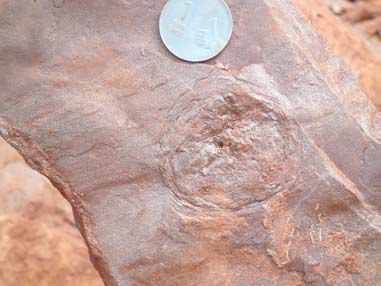
  • Circular impression on a slab of red sandstone with a coin for scale.
    Medusoid impression in the Marwar Supergroup, with a coin for scale. Prasad and De, News GSI, 2012.
  • Slab of dark red sandstone with several small impressions and a 2 cm scale bar.
    Slab with several impressions, Sonia Formation. De and Prasad, 2012.
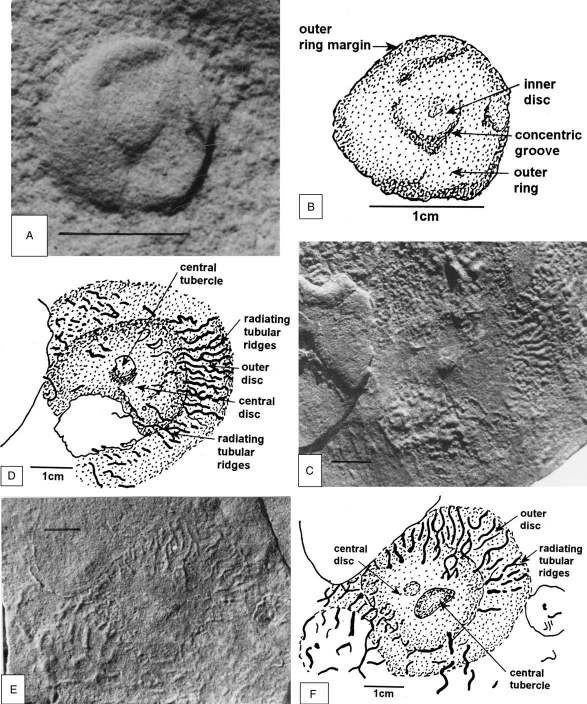
  • Black and white plate of fossil impressions with interpretive drawings from the Vindhyan Supergroup.
    Impressions and interpretive drawings from the Bhander Group, Vindhyan Supergroup. De, Journal of Asian Earth Sciences, 2006.
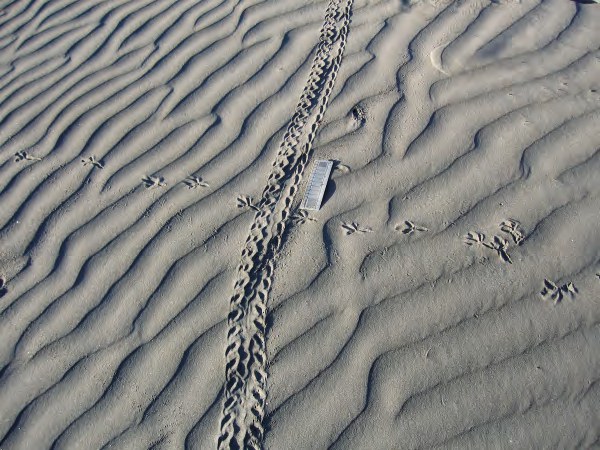
  • A crab trackway running diagonally across rippled beach sand.
    Crab trackway across rippled sand on the Bay of Bengal coast. De, Indian Journal of Geosciences, 2010.
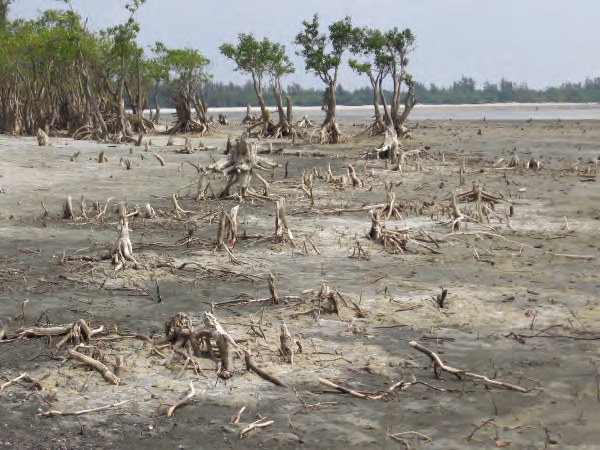
  • Dead mangrove stumps and roots exposed on a retreating beach.
    Dead mangrove stumps exposed on a retreating Sundarban shore. De, Indian Journal of Geosciences, 2010.
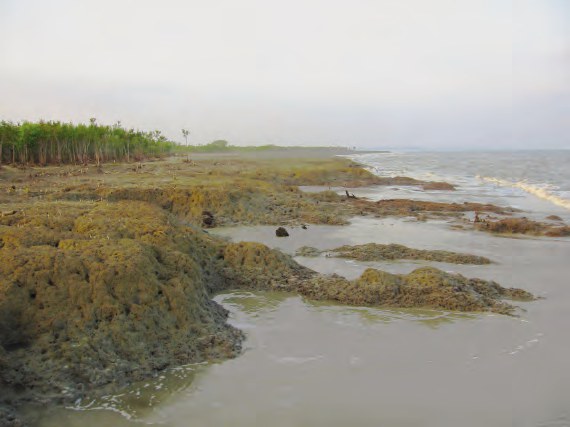
  • Blocks of dark mud on a tidal flat with the sea beyond.
    Eroding mud banks on the Sundarban tidal flats. De, Indian Journal of Geosciences, 2010.
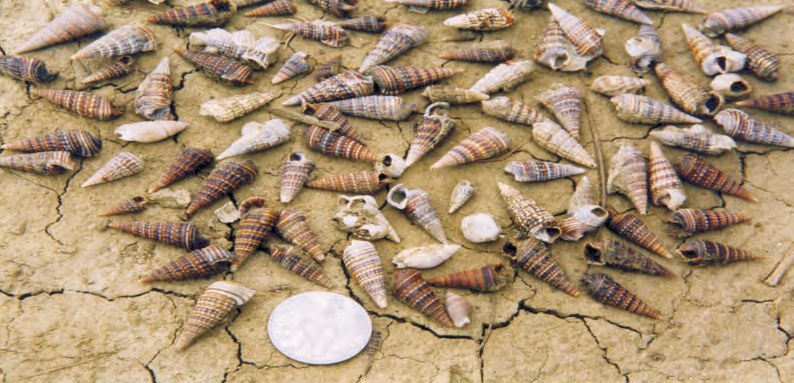
  • Dozens of spiral gastropod shells scattered on cracked dry mud with a coin for scale.
    Gastropod shells on a dried mudflat, with a coin for scale. De, Indian Journal of Geosciences, 2010.
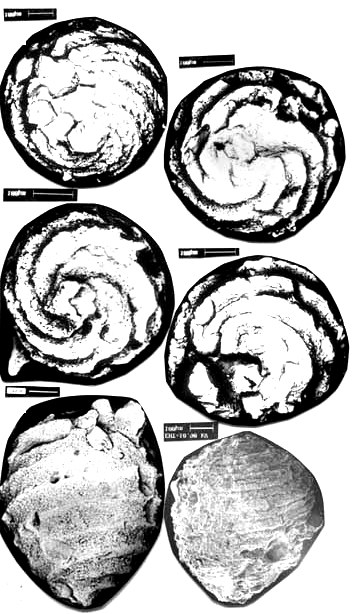
  • Scanning electron micrographs of spiral-ribbed charophyte gyrogonites.
    Charophyte gyrogonites from the Permian Barakar Formation, Talchir Basin, under the scanning electron microscope. De, Current Science, 2003.
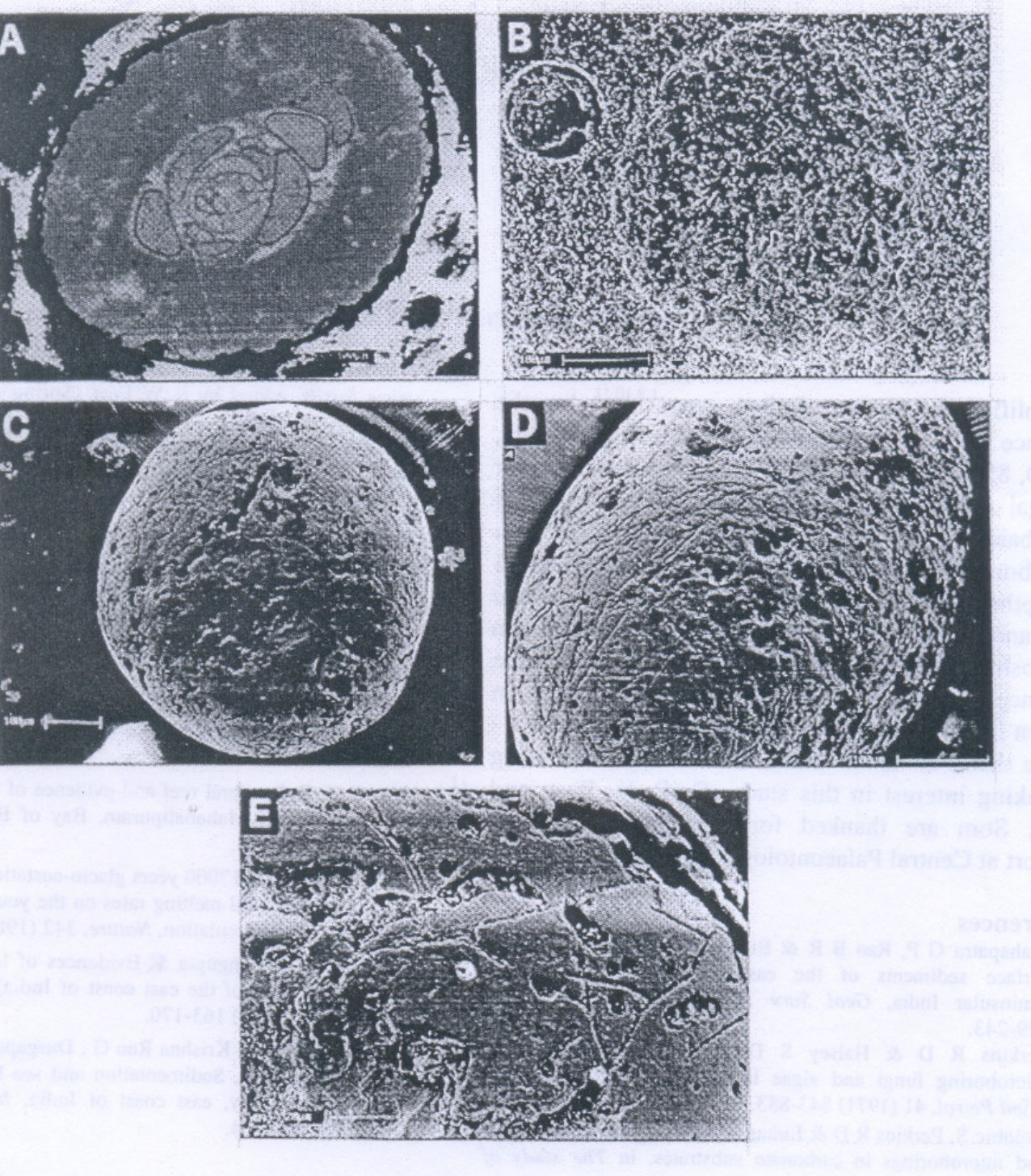
  • Scanning electron micrographs of spherical ooids with bored surfaces.
    Algal microborings on Holocene ooids from off the Bengal coast, under the scanning electron microscope. Bandopadhaya and De, 2000.

Discoveries

  • 2001

    The oldest rain imprints in the world

    Raindrop craters on a Vindhyan tidal flat in eastern Madhya Pradesh, more than a billion years old. Recognised by Guinness World Records in 2005 and reproduced in Science.

  • 2003

    Ediacaran organisms in the Vindhyans

    The first Ediacara-type fossil assemblage from the Bhander Group, placing the Vindhyan basin on the world map of late Neoproterozoic life and prompting his "critical zone" idea for the gap in the early animal record.

  • 2002

    A worm tube that measures the beach

    Diopatra tubes, structured differently above and below the sediment surface, as a ready gauge of annual erosion and deposition. A reviewer called the idea "an egg of Columbus".

  • 2005

    Burrows that point to buried rivers

    Oriented crustacean burrows in Quaternary deposits of the Banas basin, Gujarat, used to trace palaeochannels and locate groundwater in a drought-prone district.

  • 2005

    A biophysical model of crab burrowing

    How intertidal crabs dig, and why burrow shape tracks tide, storm, and sea level. Introduced burrow cycles and bathymetric burrow zonation for reading transgressive and regressive sequences.

  • 2008

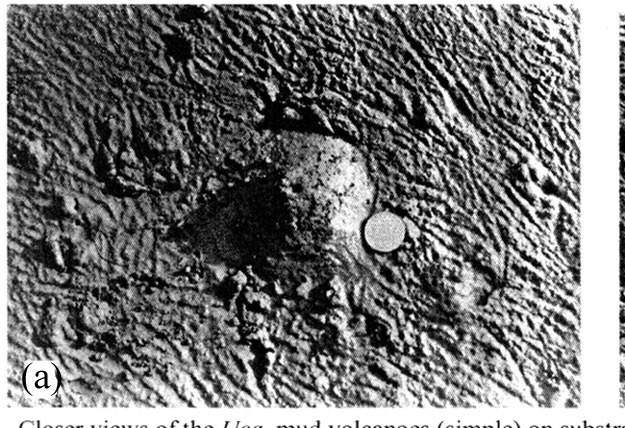
    Fiddler-crab mud volcanoes as a stability gauge

    Biogenic mud mounds of Uca marionis on the Bengal coast as a quick field indicator of unstable beach segments.

Career

  • 1972 to 1974 B.Sc. (Hons) and M.Sc. in Geology, University of Calcutta
  • 1978 to 1980 Junior Research Fellow, Jadavpur University

    UGC fellowship under Professor S. K. Bakshi, studying crab burrows of the Sundarban delta.

  • 1980 to 1984 Geologist, Northern Region, Ladakh Project

    Mapping and palaeontology in the Zanskar Himalaya, based in Srinagar.

  • 1984 to 1990 Geologist, Western Region, Operation Gujarat

    Quaternary geology of the Banas basin and the Gujarat coast, based in Jaipur.

  • 1990 to 2009 Senior Geologist, then Superintending Geologist, Palaeontology Division, Kolkata

    Gondwana ichnology in Orissa and Bihar, the Vindhyan and Chhattisgarh Proterozoic programmes, and the Bengal coast studies. Ph.D. from the University of Calcutta in 2008 on the neoichnology of the Sundarban delta, under Dr. T. K. Mallik.

  • 2009 to 2012 Director (Senior Grade), Palaeontology Division and Regional Mission Head, Western Region, Jaipur

    Ediacaran and early Cambrian fossils of the Marwar Supergroup, Rajasthan. Retired 30 September 2012.

He trained national and international trainee geologists at the GSI's Kuju centre for five years, has been a life member of the Mining, Geological and Metallurgical Institute of India since 1997, and has reviewed for Current Science, the Journal of the Geological Society of India, the Indian Journal of Geology, Indian Minerals, and the Indian Journal of Earth Sciences.

Books

  • A History of Ideas in Ichnology With A. Baucon and 27 co-authors, in Trace Fossils as Indicators of Sedimentary Environments, Developments in Sedimentology 64, Elsevier, 2012.

    Invited to represent Indian ichnology in the international history chapter of the field's standard reference.

  • Quaternary Geological Evolution of Gujarat With U. B. Mathur. Memoirs of the Geological Survey of India 134, 2007.

    The inland Banas river basin and the Bhavnagar coast.

  • A Palaeobiological Catalogue of Rajasthan and Gujarat With P. Mukherjee. GSI Fossil Catalogue Series, 2012.
  • Changing Concepts of the Evolution of Early Life With A. K. Moitra, in S. P. Dasgupta (ed.), The Living Earth, School of Fundamental Research, Calcutta, 1997.

Publications

Papers in refereed journals, by decade. Where a PDF is available it opens in Google Drive. Papers marked with a red asterisk appeared in international journals.

2010 to 2012

  • 2012Prasad, S. and De, C. Records of Lower Cambrian (Tommotian) life in the Marwar Supergroup of Rajasthan: their palaeoenvironment, palaeobiogeography and significance in Pc-C boundary delineation. Indian Journal of Geosciences 66(2-3), 119-132.
  • 2012De, C. and Prasad, S. Ediacaran fossil assemblage from Sonia Formation, Jodhpur Group, Rajasthan. Indian Journal of Geosciences 66(2-3), 93-118.PDF
  • 2011De, C. and Prasad, S. Discovery of Vendian Ediacaran fossil assemblage from the Marwar Supergroup, Rajasthan. Indian Journal of Geosciences 65(3), 241-242.PDF
  • 2012Prasad, S. and De, C. Maiden palaeontological delineation of Pc-C boundary from Peninsular Proterozoic basin of Rajasthan. Indian Journal of Geosciences 65(3).PDF
  • 2011Pal, T., Sankar, M. S., Bhattacharya, A. and De, C. A misleading "Turtle Rock" from pelagic sediments of Andaman ophiolite. Current Science 101(7), 847-848.PDF
  • 2010De, C. Sundarban Delta Complex: a special feature. Indian Journal of Geosciences 63(4), 397-428.PDF

2000 to 2009

  • 2009De, C. The Vindhyan Ediacaran fossil and trace fossil assemblages: their insight into early metazoan palaeobiology, palaeobiogeography and Vindhyan biostratigraphy. Indian Journal of Geosciences 63(1), 11-40.PDF 1234
  • 2008De, C. Uca marionis mud volcanoes: a unique ichnological tool from the Bay of Bengal coast of India for ready assessment of beach stability. Marine Georesources and Geotechnology 27(2), 79-95. *PDF
  • 2007De, C. and Mathur, U. B. Quaternary geological evolution of Gujarat with special reference to the inland Banas river basin and Bhavnagar coast, Gujarat, western India. Memoirs of the Geological Survey of India 134.
  • 2006De, C. Ediacara fossil assemblage in the upper Vindhyans of central India and its significance. Journal of Asian Earth Sciences 27(5), 660-683. *PDF
  • 2006De, C. Vindhyan trace fossils, dubiofossils and pseudofossils in the light of advent and early evolution of metazoans. Indian Minerals, Diamond Jubilee volume 60(1-2), 1-38.PDF, part
  • 2005De, C. Biophysical model of intertidal beach crab burrowing: application and significance. Ichnos 12(1), 11-29. *
  • 2005De, C. Quaternary ichnofacies model for palaeoenvironmental and palaeosealevel interpretations: a study from the Banas River Basin, western India. Journal of Asian Earth Sciences 25(2), 233-249. *
  • 2005Raghav, K. S., De, C. and Jain, R. L. The first record of Vendian medusoids and trace fossil-bearing algal matgrounds from the basal part of the Marwar Supergroup of Rajasthan, India. Indian Minerals 59(1-2), 23-30.
  • 2003De, C. Possible organisms similar to Ediacaran forms from the Bhander Group, Vindhyan Supergroup, late Neoproterozoic of India. Journal of Asian Earth Sciences 21(4), 387-395. *PDF
  • 2003De, C. First record of charophytes from the Permian Barakar Formation of the Talchir Gondwana Basin, Orissa. Current Science 84(8), 987-989.PDF
  • 2002De, C. Continental mayfly burrows within relict-ground in inter-tidal beach profile of Bay of Bengal coast: a new ichnological evidence of Holocene marine transgression. Current Science 83(1), 64-67.PDF
  • 2002De, C. Application of a biological tool for estimating current annual rates of erosion and deposition in modern coastal environments: a case study in the Bay of Bengal coast. Marine Georesources and Geotechnology 20(3), 209-220. *PDF
  • 2002De, C. Oldest charophytes from Indian Gondwanas: a report from the Permian Barakar Formation, Talchir Basin, Orissa. Indian Minerals 56(3-4), 227-238.
  • 2001De, C. Billion-year-old rain-imprinted tidal sea-coast in eastern Madhya Pradesh, India. Current Science 81(8), 1116-1124.PDF
  • 2001De, C. Marine influence in the Indian Gondwana basins: a review from ichnological findings. Journal of the Geological Society of India 57(5), 411-416.
  • 2000De, C. Neoichnological activities of endobenthic invertebrates in downdrift coastal Ganges Delta Complex, India: their significance in trace fossil interpretations and paleoshoreline reconstructions. Ichnos 7(2), 89-113. *PDF
  • 2000Bandopadhaya, A. and De, C. Algal micro-boring on ooids: an evidence of Holocene sea transgression in eastern India. Indian Journal of Marine Sciences 29(2), 181-184.PDF
  • 2000De, C. Environmental interpretations of detrital quartz-sand surface microstructures by electron microscopy: a study on the Quaternaries in parts of Gujarat. Indian Minerals 54(3-4), 183-200.

1990 to 1999

  • 1999De, C. Algal stromatolites and entrapped marine cyanophytes from the Talchir Limestones, Talchir Basin, Orissa: a strong evidence of Middle Talchir marine transgression. Indian Journal of Geology 71(3), 205-212.
  • 1999De, C. Evidences of Late Triassic volcanism in the Kamthi Formation, Talchir coalfield, Orissa. Indian Minerals 53(3-4), 199-204.
  • 1999Bhatt, D. K., Singh, G., Gupta, S., Soni, M. K., Moitra, A. K., Das, D. P. and De, C. Fossil report from Semri Group, Lower Vindhyan. Journal of the Geological Society of India 53, 717-723.
  • 1998De, C. Biological reworking of sediments by crabs: a cause for erosion of the Digha beach, West Bengal. Current Science 75(6), 617-620.PDF
  • 1998De, C. Palaeozoic-Mesozoic ichnocoenoses from Rupshu area, Zanskar Himalaya, India. Indian Minerals 52(3-4), 159-180.
  • 1997De, C. Study of modern Turritella attenuata trails and burrows along the Bhagirathi river beds and their significance. Indian Minerals 51(1-2), 199-206.
  • 1995De, C. Environmental significance of the Quaternary lebensspuren of the Banas River Basin of Gujarat, India. Indian Minerals 49(1-2), 13-30.
  • 1994De, C., Das, D. P. and Raha, P. K. Ichnostratigraphic and palaeoenvironmental significance of trace fossils from Tal Formation of the Nigali Dhar syncline, Sirmur District, Himachal Pradesh, India. Indian Journal of Geology 66(2), 77-90.
  • 1993De, C. Trace fossils in the Precambrian-Cambrian boundary delineation and a case study from the Liddar valley, Kashmir, India. Indian Minerals 47(2), 131-144.
  • 1993De, C. Skolithos ichnofacies in the Barakar Formation of Hazaribagh, India and its fine resolution depositional and ecological significance. Gondwana Geological Magazine, special volume, 512-521.
  • 1991De, C. New finding of Burgundia spp. (a Hydrozoa) from the Zanskar Himalaya, Ladakh, India. Geological Survey of India Special Publication 16, 9-11.
  • 1991De, C. Presence of detrital scheelite grains in the Quaternary fluvial deposits of Banaskantha district of north Gujarat and its significance. Indian Minerals 45(4), 325-330.
  • 1990De, C. Upper Barakar lebensspuren from Hazaribagh, India. Journal of the Geological Society of India 36, 430-438.

1980 to 1981

  • 1981De, C. and Bakshi, S. K. Geological significance of burrows produced by the crab Uca marionis on salt marsh riverbank of inner Sundarban Delta complex, India. Geophytology 11(1), 80-89.
  • 1980Bakshi, S. K., Ray, T. K. and De, C. On the workings of some crabs on the sandy beach of western Sundarban, Bengal Delta, India. Journal of the Geological Society of India 21, 184-187.
News articles in News GSI, 1987 to 2012
  • 2012Prasad, S. and De, C. Discovery of Vendian Ediacaran fossil assemblage from the Marwar Supergroup of Rajasthan. News GSI 32(1).PDF
  • 2011Molluscs and Cruziana from the Marwar Supergroup, in the Western Region newsletter. News GSI, Western Region 32(2), July to December 2011.PDF, whole issue
  • 2012De, C. and Awwal, S. New bivalves from the Eocene Khuiala Formation. News GSI 33(1).PDF
  • 2012Prasad, S. and De, C. Maiden finding of arthropod body fossils from Nagaur Group. News GSI 33(1).PDF
  • 2012De, C. and Mukherjee, P. Dinosaur map of Gujarat. News GSI 33(2).
  • 2009De, C. et al. Longest trackway of modern decapods from Bakkhali beach. News GSI 30(1-2), 13-14.PDF
  • 2008De, C. Finding of Teredolites ichnofacies in the Bakkhali beach, Bay of Bengal coast and its environmental significance. News GSI 37(3-4), 19-20.
  • 2007De, C. First record of lungfish burrows from Indian Gondwanas. News GSI 38(1), 24-25.
  • 2007De, C. Estuarine ichnocoenose from Upper Barakar Formation, Raniganj Basin, West Bengal. News GSI 38(2), 24.
  • 2006De, C. Discovery of Ediacaran fossil assemblage in the Vindhyans. News GSI 37(1-2).
  • 2006De, C. Finding of Vendian filamentous algae Zinkovioides spp. in the Raipur Group of the Chhattisgarh Basin. News GSI 37(3-4).
  • 2004De, C. Cnidarian remains in the upper Vindhyans of M.P. News GSI 35(1-2), 20.
  • 2004De, C. Biogenic mud mounds in the Bakkhali beach, West Bengal and their significance. News GSI 35(3-4), 24.
  • 2002De, C. Oldest Gondwana charophytes from Talchir Basin, Orissa. News GSI 33(1-2), 17.
  • 2002De, C. A significant metaphyte assemblage in the lower Vindhyans. News GSI 33(3-4), 12.
  • 2002De, C. Biomat-dependent early metazoan activities in upper Vindhyan of M.P. News GSI 33(1-2), 29-31.
  • 2001De, C. Vindhyan microfossils from Satna, M.P. News GSI 32(1-4), 90.
  • 2000De, C. New late Neoproterozoic worm burrows from the Vindhyan of Madhya Pradesh. News GSI 31(3-4), 46-47.
  • 1999De, C. Fossil algae in budding stages. News GSI 30(1-2), 12-13.
  • 1999De, C. Study of Middle/Late Proterozoic organic community succession and ecology in the Bhander Group (Vindhyan Supergroup) of eastern Madhya Pradesh. News GSI 30(1-2), 18-19.
  • 1999De, C. Soft-bodied metazoan impressions from the Bhander Group (Vindhyan Supergroup). News GSI 30(3-4), 1-2.
  • 1998De, C. Pelletal designs by the crab Ocypode spp. News GSI 29(1-2), 47.
  • 1998Moitra, A. K. and De, C. Primitive trace fossils from Vindhyans. News GSI 29(1-2), 47-48.
  • 1995Moitra, A. K. and De, C. Primitive Planolites worm burrows from Badami Quartzites, Karnataka. News GSI 25-26, back cover.
  • 1993De, C. Insect burrow as an index of semi-desertic inter-dunal trough environment. News GSI 23(4), 18.
  • 1992De, C. Quaternary ichnological study. News GSI 23(2-3), 9-11.
  • 1987De, C. New finds of marine sediments from the Early Quaternary of northern Gujarat. News GSI (WR) 6, 10-15.
  • 1987De, C. Burrow casting with paraffin wax. News GSI (WR) 6, 16.
Records of the Geological Survey of India, 1989 to 2008
  • 2008De, C. Study of the Proterozoic life of the Chhattisgarh Basin in the light of early organic evolution, biostratigraphy and palaeoenvironments. Records GSI 140(2), 15-18.
  • 2007De, C. Study of the Proterozoic life of the Chhattisgarh Basin in the light of early organic evolution, biostratigraphy and palaeoenvironments. Records GSI 139(2), 12-15.
  • 2006De, C. Study of the Proterozoic biomat-grounds and associated organisms of the Vindhyan Supergroup, Madhya Pradesh, with data input from modern analogues in the Bay of Bengal coastal areas. Records GSI 138(2), 12-14.
  • 2005De, C. Study of the Proterozoic biomat-grounds and associated organisms of the Vindhyan Supergroup, Madhya Pradesh, with data input from modern analogues in the Bay of Bengal coastal areas. Records GSI 137(2), 29-32.
  • 2002De, C. Study of the Proterozoic life of the Vindhyan sequence of western Son Valley, Madhya Pradesh. Records GSI 135(2), 28-29 and 136(2), 34-35.
  • 2001De, C. Study of Middle/Late Proterozoic organic community succession and ecology in the Bhander Group of eastern M.P. Records GSI 134(2), 31-34.
  • 2000De, C. Study of Middle/Late Proterozoic organic community succession and ecology in the Bhander Group of eastern M.P. Records GSI 133(2), 28-29.
  • 1999De, C. Study and evaluation of metazoans and microfossils in parts of Vindhyan Supergroup at Satna and Sidhi districts, M.P. Records GSI 132(2), 23-24.
  • 1998De, C. Study and evaluation of metazoans and microfossils in parts of Vindhyan Supergroup at Satna and Sidhi districts, M.P. Records GSI 131(2), 12-13.
  • 1997De, C. Study of trace fossils of the Gondwana sequences (Barren Measure and Kamthi Formations) of the Brahmani Valley, Orissa, with special reference to marine transgression in Gondwanaland. Records GSI 130(2), 3-4.
  • 1996De, C. Ichnological study of Gondwana sediments, Talchir coalfield, Orissa, with special reference to marine transgression in Gondwanaland. Records GSI 129(2), 3-4.
  • 1995Moitra, A. K. and De, C. Palaeontological and biostratigraphic studies of the Late Proterozoic and Early Palaeozoic basins of Andhra Pradesh. Records GSI 128(2), 2.
  • 1994De, C. Quaternary ichnological study in Bengal Basin. Records GSI 127(2), 6-8.
  • 1993De, C. A new technique of burrow casting in terrestrial sediments and its applicability. Records GSI 126, 151-154.
  • 1993De, C. Palaeoecological significance of some upper Barakar trace fossils from west Barakar coalfield, Hazaribagh district, Bihar. Records GSI 126, 145-149.
  • 1993De, C. Quaternary ichnological study in Bengal Basin. Records GSI 126, 12-13.
  • 1989De, C. Quaternary geological mapping in Gujarat. Records GSI 122(7), 21.
Conference and seminar papers
  • 2012De, C. Evidences of rising sea level and retreating Sundarban coast of the Bay of Bengal. UGC Conference on Recent Researches in Earth System Science, Kolkata.
  • 2006De, C. The Vindhyan Ediacaran fossils and trace fossils in the light of metazoan evolution. Keynote address. National Seminar on Precambrian Life, Durgapur Government College, 21-22.
  • 2003De, C. Ichnological evidences of Holocene marine transgression in the Bay of Bengal coast, West Bengal, India. Proceedings of the 4th GEOSAS Seminar, New Delhi, 302-311. *
  • 1991De, C. and Mathur, U. B. Environmental analysis of Quaternary ichnofacies developed in Banas river basin of north Gujarat, India. IGCP 274, Evolution of west coast of India during Quaternary and modern coastal processes, Goa. *
  • 1991De, C. and Mathur, U. B. Interpretation of Quaternary geoenvironmental history and geomorphic scenario from the SEM study of surface microstructures of quartz detritals of inland and coastal deposits of Gujarat, India. IGCP 274, Goa. *
  • 1988De, C. and Mathur, U. B. New find of oolitic calcareous sediments from the north Gujarat, India. Proceedings of the National Seminar on Recent Quaternary Studies in India, MSU Baroda, 155-163.